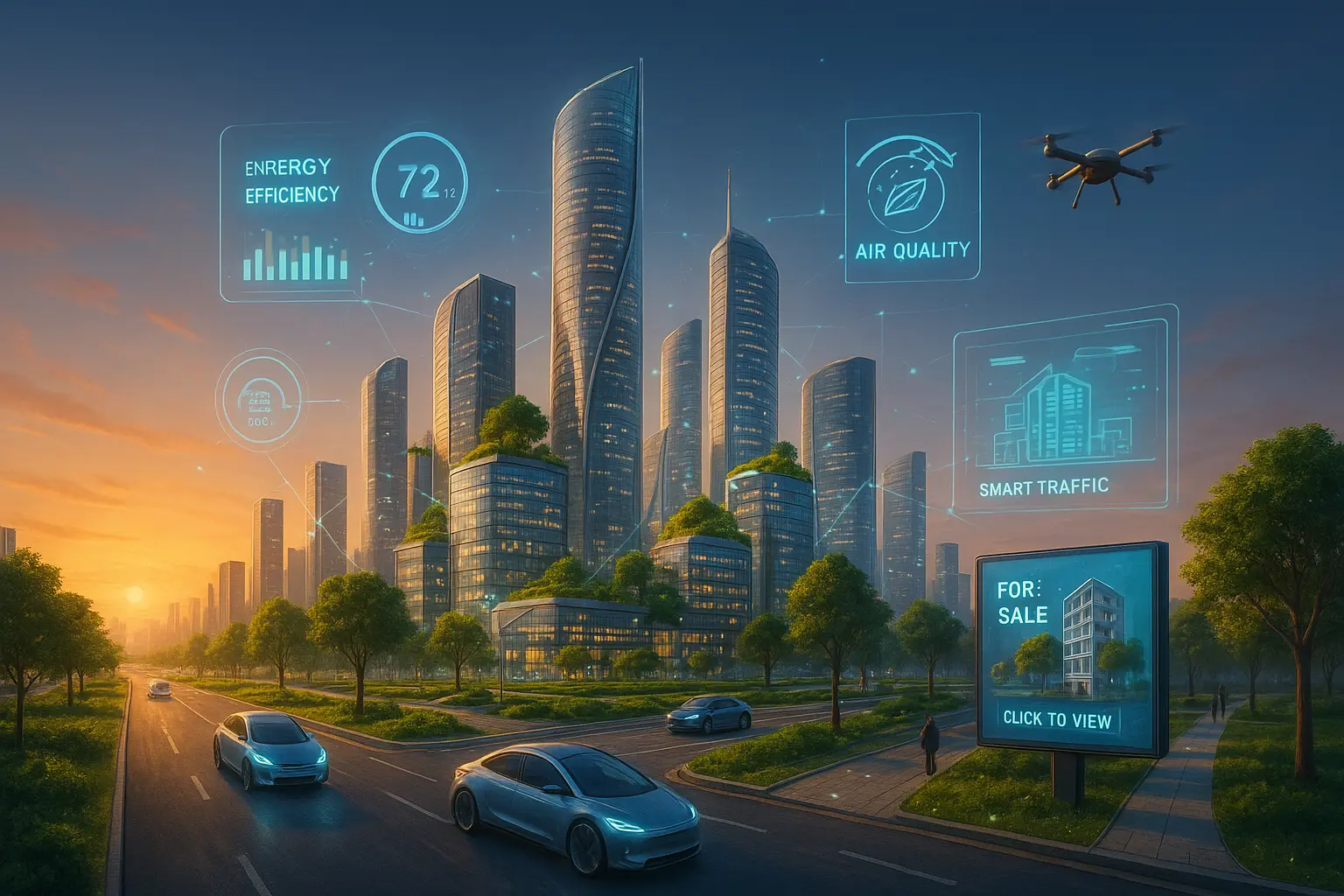

Urbanization is transforming the world’s cities at an unprecedented rate. As cities become increasingly complex, the need for efficient, sustainable, and connected infrastructure is becoming more pressing. The emergence of smart cities and the Internet of Things (IoT) is revolutionizing the real estate industry.

The integration of IoT technologies is creating new opportunities for smart real estate, from intelligent buildings and homes to commercial and industrial properties. As the industry continues to evolve, it’s essential to understand the current state of smart real estate, the key technologies driving this transformation, and the challenges and opportunities that lie ahead.
Understanding Smart Cities and IoT in Real Estate
Smart cities and IoT are redefining the future of urban living and real estate development. The integration of technology and data is creating more efficient, sustainable, and livable environments.
Defining Smart Cities in the Modern Context
Smart cities leverage advanced technologies to enhance urban operations. Key components include connected infrastructure, data analytics, and IoT devices.
Key Components of Smart Urban Development
Connected infrastructure is the backbone of smart cities, enabling real-time monitoring and management of urban systems. This includes smart grids, intelligent transportation systems, and public safety networks.
Evolution from Traditional to Smart Cities
The transition to smart cities involves adopting new technologies that facilitate data-driven decision-making. Cities are becoming more responsive to the needs of their citizens.
The Role of IoT in Transforming Urban Spaces
IoT plays a critical role in this transformation by providing the necessary connectivity and data.
Connected Devices and Infrastructure
IoT devices are being integrated into urban infrastructure, creating a network of connected devices that enhance city operations.
Data Collection and Utilization
Data collected from IoT devices is used to optimize urban services, improve public safety, and reduce environmental impact.
Convergence of Technology and Real Estate
The convergence of technology and real estate is giving rise to new opportunities for innovation and investment in smart cities.
The Current State of Smart Real Estate in America
America’s real estate industry is undergoing a paradigm shift with the emergence of smart cities, characterized by the use of IoT and data analytics. This transformation is driven by the need for more efficient, sustainable, and livable urban environments.
Leading Smart City Initiatives Across the US
The US is home to several pioneering smart city initiatives. Notable examples include:
- New York’s Hudson Yards
- Columbus Smart City Program
New York’s Hudson Yards
Hudson Yards is one of the largest private real estate developments in the US, incorporating advanced smart city technologies. It features a sophisticated infrastructure that includes smart buildings, public spaces, and transportation systems.
Columbus Smart City Program
Columbus has been recognized for its smart city initiatives, particularly its efforts to improve mobility and reduce emissions. The city’s program includes the deployment of smart traffic management systems and electric vehicle charging infrastructure.
Adoption Rates of Smart Technologies in Properties
The adoption of smart technologies in properties is gaining momentum, driven by the need for efficiency, sustainability, and enhanced user experiences. Smart buildings are becoming increasingly popular, offering benefits such as energy savings and improved security.
Case Studies: Successful Smart Real Estate Projects
Several smart real estate projects across the US have achieved significant success. For instance, smart office buildings are now equipped with advanced HVAC systems and energy-efficient lighting, enhancing the working environment.
“The future of real estate is smart, and it’s happening now. Cities that adopt smart technologies will be more competitive and sustainable.”
Key Technologies Driving the Future of Real Estate: Smart Cities & IoT
The future of real estate is being shaped by several key technologies. The convergence of these technologies is transforming the real estate landscape, making it more efficient, sustainable, and user-friendly.
Sensor Networks and Data Collection Systems
Sensor networks and data collection systems are enabling real-time monitoring and management of properties. These systems can track various parameters such as energy usage, occupancy rates, and environmental conditions, allowing for data-driven decision-making.
AI and Machine Learning Applications
AI and machine learning are being applied to optimize property operations, predict maintenance needs, and enhance user experiences. For instance, AI-powered chatbots can assist tenants with their queries, improving customer service.
Blockchain for Real Estate Transactions
Blockchain technology is being explored for its potential to streamline real estate transactions and improve security. It can facilitate transparent and tamper-proof transactions, reducing the need for intermediaries.
5G and Advanced Connectivity Solutions
5G and advanced connectivity solutions are facilitating faster, more reliable data transfer, enabling new applications such as virtual property tours and remote transactions.
Impact on Real-time Property Management
The integration of 5G with IoT devices is revolutionizing real-time property management. It enables swift data transfer, allowing property managers to respond quickly to changing conditions.
Enhanced Virtual Property Tours and Remote Transactions
5G is also enhancing virtual property tours, making them more immersive and interactive. This technology is facilitating remote transactions, making it easier for buyers and sellers to complete deals without being physically present.
| Technology | Application in Real Estate | Benefits |
|---|---|---|
| Sensor Networks | Real-time monitoring | Improved efficiency, reduced costs |
| AI & Machine Learning | Predictive maintenance, customer service | Enhanced user experience, reduced maintenance costs |
| Blockchain | Secure transactions | Increased security, transparency |
| 5G | Fast data transfer, virtual tours | Improved remote transactions, enhanced virtual experiences |
Smart Buildings: The New Standard in Real Estate
Smart buildings are redefining the real estate landscape, offering enhanced efficiency and user experiences. These buildings are equipped with advanced technologies that optimize various aspects of building management.
Automated Building Management Systems
Automated building management systems are a crucial component of smart buildings. They integrate various building systems, such as HVAC, lighting, and security, into a single, cohesive network.
HVAC Optimization and Indoor Air Quality
HVAC optimization is a key feature of automated building management systems. It ensures that heating, ventilation, and air conditioning systems operate efficiently, maintaining optimal indoor air quality.
Predictive Maintenance Solutions
Predictive maintenance solutions enable building managers to anticipate and address potential issues before they become major problems, reducing downtime and improving overall building performance.
Energy Efficiency and Sustainability Features
Smart buildings incorporate various energy-efficient features, such as LED lighting and energy-harvesting systems, to reduce their environmental footprint.

Security and Access Control Innovations
Smart buildings also feature advanced security and access control systems, including biometric authentication and contactless entry.
Biometric Systems and Contactless Entry
Biometric systems and contactless entry solutions provide secure and convenient access control, enhancing building security.
Integrated Security Monitoring
Integrated security monitoring systems enable real-time monitoring and response to security incidents, ensuring a safe and secure environment for occupants.
| Feature | Benefits | Impact |
|---|---|---|
| Automated Building Management | Improved Efficiency, Reduced Energy Consumption | Enhanced Building Performance |
| Energy Efficiency Features | Reduced Energy Consumption, Lower Operating Costs | Environmental Sustainability |
| Security Innovations | Enhanced Security, Improved Access Control | Increased Occupant Safety |
Residential Transformations: Smart Homes in Connected Communities
The integration of IoT technologies is driving the transformation of residential real estate, making smart homes the new norm in connected communities. This shift is not just about individual homes; it’s about creating a network of intelligent living spaces that enhance the quality of life for residents.
Home Automation and IoT Integration
Smart homes are becoming increasingly sophisticated with the integration of home automation systems and IoT technologies. Voice-controlled smart home systems are at the forefront of this transformation, allowing residents to control lighting, temperature, and security with ease.
Voice-Controlled Smart Home Systems
Systems like Amazon Alexa and Google Home are revolutionizing the way we interact with our living spaces, making it easier to manage daily tasks.
Energy Management and Cost Savings
IoT integration also enables advanced energy management systems, which help reduce energy consumption and costs. By optimizing energy usage, smart homes contribute to a more sustainable future.
Community-Wide Smart Systems
Beyond individual homes, community-wide smart systems are being developed to enhance the living experience. These include shared resources and amenities that benefit all residents.
Shared Resources and Amenities
Community-wide smart systems allow for the efficient management of shared resources, such as community centers and parks.
Neighborhood Safety and Communication Networks
Moreover, these systems improve neighborhood safety through advanced surveillance and communication networks, fostering a safer community environment.
Impact on Property Values and Market Demand
The transformation into smart homes and connected communities is significantly impacting property values and market demand. As homebuyers increasingly seek out smart homes, the real estate market is responding with more innovative and connected living solutions.
Commercial Real Estate in the Age of Smart Cities
As urban areas evolve into smart cities, commercial real estate is being reshaped by innovative IoT solutions. The integration of IoT technologies is transforming the way commercial properties operate, making them more efficient, sustainable, and responsive to the needs of occupants.
Workspace Evolution Through IoT
The modern workspace is undergoing a significant evolution, driven by the adoption of IoT technologies. This transformation is manifest in various ways, including the implementation of hot-desking and space utilization analytics, as well as the integration of employee experience and productivity tools.
Hot-Desking and Space Utilization Analytics
Hot-desking, a practice where employees share workspaces rather than having assigned desks, is becoming increasingly popular. When combined with space utilization analytics, which use sensors and data analytics to understand how office spaces are used, businesses can optimize their real estate footprint and reduce costs.
Employee Experience and Productivity Tools
IoT-enabled tools are also being used to enhance employee experience and productivity. For example, smart lighting and temperature control systems can improve comfort and reduce energy consumption.
Retail Spaces and Customer Experience Technologies
Retail spaces are being transformed by customer experience technologies, including personalized marketing and smart signage. These technologies enable retailers to create more engaging and personalized shopping experiences, driving customer loyalty and sales.
Industrial Properties and Smart Logistics
Industrial properties are also benefiting from IoT technologies, particularly in the realm of smart logistics. This includes the use of warehouse automation and inventory management systems, as well as last-mile delivery optimization.
Warehouse Automation and Inventory Management
Warehouse automation is improving efficiency and reducing costs by minimizing manual labor and maximizing storage capacity.
Last-Mile Delivery Optimization
Last-mile delivery optimization is enhancing the customer experience by ensuring faster and more reliable delivery of goods.
Sustainability and Environmental Impact of Smart Real Estate
Smart real estate is at the forefront of reducing environmental impact through innovative technologies. The integration of sustainability into smart real estate is not just a trend, but a necessity driven by the need to minimize carbon footprints and promote eco-friendly practices.
Reducing Carbon Footprints Through Smart Technology
One of the significant advantages of smart real estate is its ability to reduce carbon footprints. This is achieved through energy-efficient systems that optimize energy consumption and reduce waste. For instance, smart buildings can automatically adjust lighting and heating/cooling systems based on occupancy and external weather conditions, significantly reducing energy usage.
As Mark Zuckerberg once said, “The biggest risk is not taking any risk.” In the context of smart real estate, taking the risk to adopt new, sustainable technologies is paying off in terms of reduced environmental impact.
Water Conservation and Management Systems
Smart real estate also focuses on water conservation through advanced management systems. These systems monitor water usage in real-time, detect leaks, and optimize water distribution. This not only reduces water waste but also helps in maintaining the infrastructure of the building.
“Sustainability is no longer a choice but a business imperative.” –
Anonymous
Green Building Certifications in Smart Developments
Green building certifications such as LEED and WELL are becoming increasingly important in smart real estate developments. These certifications ensure that buildings meet specific standards for sustainability and environmental performance.
LEED, WELL, and Smart Building Standards
LEED (Leadership in Energy and Environmental Design) and WELL are two prominent certifications that promote sustainable building practices. LEED focuses on energy efficiency, water conservation, and indoor environmental quality, while WELL emphasizes occupant health and well-being.
- LEED certification involves a point system based on various sustainability criteria.
- WELL certification focuses on factors like air quality, lighting, and thermal comfort.
Financial Incentives for Sustainable Smart Buildings
There are various financial incentives available for developers who adopt sustainable practices in their smart building projects. These incentives can include tax credits, grants, and preferential financing terms.
For example, the U.S. government offers tax deductions for energy-efficient buildings under the Energy Policy Act. Such incentives encourage developers to invest in sustainable technologies.
Stakeholder Perspectives on Smart City Development
Stakeholders from diverse backgrounds are coming together to drive smart city initiatives. The development of smart cities involves multiple stakeholders, including real estate developers, government authorities, and residents, each bringing their unique perspectives to the table.
Real Estate Developers and Investors
Real estate developers and investors are crucial stakeholders in smart city development. They are considering Return on Investment (ROI) when implementing smart technologies.
ROI Considerations for Smart Technology Implementation
Developers are evaluating the cost-benefit analysis of integrating smart technologies into their projects.
Future-Proofing Development Projects
They are also focusing on future-proofing their developments to stay competitive in a rapidly evolving market.
Government and Municipal Authorities
Government authorities play a vital role in promoting smart city development through policies and regulations.
Residents and End-Users
Residents benefit from enhanced accessibility and user experiences in smart cities.
Accessibility and User Experience Factors
The focus is on creating user-friendly interfaces and ensuring that smart city technologies are accessible to all.
Addressing the Digital Divide
Efforts are being made to address the digital divide, ensuring that all residents can benefit from smart city initiatives.

Challenges and Opportunities in Smart Real Estate
As smart real estate continues to evolve, it brings forth a mix of challenges and opportunities that stakeholders must navigate. The development of smart cities and the integration of IoT technologies in real estate are transforming the landscape, presenting both hurdles and avenues for growth.
Infrastructure Investment Requirements
A significant challenge in the adoption of smart real estate is the infrastructure investment requirement. Developing the necessary infrastructure to support smart technologies, such as sensor networks and advanced connectivity solutions, demands substantial financial investment.
Regulatory and Policy Considerations
Regulatory frameworks play a crucial role in the development of smart real estate. Policymakers must balance innovation with consumer protection, ensuring that regulations support the growth of smart technologies while safeguarding public interests.
Data Privacy and Cybersecurity Concerns
The increased use of IoT devices in smart real estate raises significant data privacy and cybersecurity concerns. Ensuring the security of data collected by smart devices is paramount to maintaining user trust and complying with data protection regulations.
Emerging Investment Opportunities
Despite the challenges, smart real estate presents numerous emerging investment opportunities. Innovations in PropTech startups and the development of smart REITs (Real Estate Investment Trusts) are creating new avenues for investors.
PropTech Startups and Innovation
PropTech startups are driving innovation in the real estate sector, offering solutions that enhance property management, improve customer experiences, and streamline transactions.
Smart REITs and Investment Vehicles
Smart REITs and other investment vehicles are providing investors with opportunities to capitalize on the growth of smart real estate, offering diversified portfolios and potentially higher returns.
The future of smart real estate is marked by both challenges and opportunities. By understanding and addressing the former, stakeholders can capitalize on the latter, driving growth and innovation in the sector.
Conclusion: Preparing for the Smart Real Estate Future
As the real estate industry continues to evolve, embracing the smart real estate future is crucial for creating more efficient, sustainable, and livable environments. Understanding the key technologies driving this transformation, such as IoT and AI, is essential for stakeholders to make informed decisions.
Preparing for smart real estate involves not only adopting new technologies but also addressing the challenges that come with them, including infrastructure investment requirements and data privacy concerns. By doing so, we can unlock emerging investment opportunities and enhance the quality of life for residents and users.
The smart real estate future is promising, with potential for significant growth and innovation. As cities become increasingly connected, the role of smart technologies in transforming urban spaces will continue to expand, driving the industry forward.
FAQ
What is a smart city, and how does it impact real estate?
A smart city leverages technology and data to create more efficient, sustainable, and livable environments. This transformation impacts real estate by driving the adoption of smart technologies in properties, enhancing user experiences, and creating new opportunities for innovation and investment.
How is IoT technology being used in smart buildings?
IoT technology is being used in smart buildings to optimize operations, improve energy efficiency, and enhance user experiences. This includes automated building management systems, energy management, and security and access control innovations.
What are the benefits of smart homes in connected communities?
Smart homes in connected communities offer several benefits, including enhanced user experiences, energy efficiency, and cost savings. Community-wide smart systems also create new opportunities for shared resources and amenities, as well as neighborhood safety and communication networks.
How is smart real estate impacting the environment?
Smart real estate is having a positive impact on the environment, driven by the adoption of sustainable technologies and practices. This includes reducing carbon footprints, water conservation, and green building certifications, such as LEED and WELL.
What are the challenges facing the adoption of smart real estate?
The adoption of smart real estate faces several challenges, including infrastructure investment requirements, regulatory and policy considerations, and data privacy and cybersecurity concerns.
What investment opportunities are emerging in smart real estate?
Emerging investment opportunities in smart real estate include PropTech startups and innovation, as well as smart REITs and investment vehicles. These opportunities are driven by the need for efficient, sustainable, and connected infrastructure.
How can residents benefit from smart city development?
Residents can benefit from smart city development through enhanced accessibility and user experiences, as well as improved quality of life. However, addressing the digital divide is crucial to ensuring that all residents can benefit from these developments.
What role do government and municipal authorities play in promoting smart city development?
Government and municipal authorities play a critical role in promoting smart city development through policies and regulations. They can encourage the adoption of smart technologies and sustainable practices, while also addressing regulatory and policy considerations.